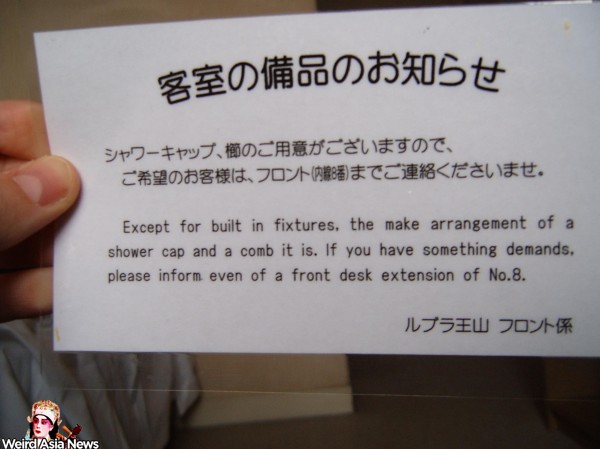
I recently replied to a post on Google’s Gmail Help forums regarding phishing, and it touched on an issue I’ve been confused about for years:
[...]
This is the result of a common translator (Google’s , Babelfish, etc.) being used on perfect grammar-from
another country.
Now for years the question has remained as to why an Asian, or other, company wouldn’t just spend a few quick dollars and have their text proof read? I’m not talking (necessarily) about the phishing expeditions, but in all matters foreign where they know an English audience will be reading their material? I’ve been to Asia, and it is crazy how proud they are of their own country and culture. They would rather spend their energy and time making a knock-off of [insert virtually any product type here] than to use that ingenuity to make
their own brand, and establish their countries as those known for making good _original_ goods, instead of really good knock-offs.
Trust me on this, as I have purchased a LOT of Asian knock-offs, and they are a terrific value-as long as you realize what they actually are.

There is no translator that converts perfect to perfect… but this next one is probably even better than the first.
The top part of the sign is in English, but when they emailed someone to translate that English into Welsh, the response actually said “I am not in the office at the moment. Please send any work to be translated.” That’s right, it’s an out of office message, which subsequently made it onto the road sign undetected. We hope those residents are getting used to Welsh truck drivers carrying heavy goods. from here.
Translation, although it would cost just a few dollars, is something I believe is outside their comfort zone with regard to national (cultural) pride.
So. Attention all Asian, Welsh and other companies wanting to get into the US markets by translating your manuals, instructions, and yes-even banners-into English: Send me your broken English and I will make it perfect. I will charge only $5 USD per document, up to 500 characters. How can you miss with that? Email me for my PayPal account!
Lets see if I can help clean up the masses of virtually unintelligible translations out there! :)
Q: With the apparent shift from a direct software solution to one of a more bundled offering with OEM providers such as Dell and HP, could you share some thoughts as what is driving this trend?
This is an old shift, and it happens all the time. While every software vendor want to burn CDs and count their money, consumers don’t, well, consume like that. All software vendors create “solutions”. That is, if you ask them. In reality, though, they are simply applications-applications that need a machine to run in/on. True solution selling involves not leaving a single decision with the prospect/customer.
Unfortunately, if all you sell is one piece of the “solution”, you are leaving other decisions out of your hands. Many times, a prospect will consider the prospect of putting all these pieces together simply too difficult, and will dismiss the entire concept. So how do you battle this?
You “package” your software as a “solution”. You take all the guesswork out of the equation by acting as the expert you purport to be and put the software in a place/configuration where it is most effective. The reasoning is that prospect/customer is, understandably, the least qualified to make this combination in a way that will work best. Hardware is no good without software, and software is no good without hardware. So why would any software company NOT want to do this?
The reason is all about money. You figured it was getting to that, right? The first cloud on the horizon is that lead exchange programs are notoriously one-sided, and always lead to rough relations between partners. In other words, who owns the account? Should the hardware folks sell a solution that they didn’t write? Will a bad solution running on their box bode well for their image/branding?
The second problem is finger pointing. In the heat of troubleshooting, it is common to divert blame (I coined the term Blame Management in the mid-90s). The customer just sees a solution that doesn’t work, and a few responsible vendors acting, well, irresponsible.
Next is the problem whereby your partner, whom you are forced to combine forces with, has an inferior product. The result is that you look bad, and all they care about is moving product, not repeat business.
Finally, the question of support. When the solution stops working, who do they call? Will the software vendor require that the customer first call the hardware vendor to rule out their hardware before they pay to take a peek? What about the other way around?
If you were a prospect given the, well, prospect of these very likely and common scenarios, you might vote to put the pieces together yourself. The vendors might well even agree with you.
Q: Do you believe this is a trend that will continue? What are the product development trends?
Like I said, this trend is set on a pendulum. Pundits like Forrester and Gartner make their money telling companies how they should change what they do. If they came in and said the last folks that were there did a great job, they couldn’t very well justify a paycheck, now could they? So do the math. If you are buying components, they will suggest “solutions”. If you have “solutions”, they will suggest “best of breed components”.
If the company can’t afford to tell one of these companies what they want to be told, they can supplant this entity with a consultant. The result is the same.
pat
:)
Part 3 (of 3) of a white paper I wrote 10 years ago for a customer that had just recently started selling professional services, but had sold product for over 20 years. This deliverable was one of several I created over the years to train sales and delivery staff in the ways of professional services and intangibles in general. Part 2 is here, and Part 1 is here.
Notes:
LEGACY refers to the existing, outdated process of selling.
Confidential refers to the company itself.
What Decides Whether a Project Should Be Approved?
You may well be pushing your project through channels that are not as familiar with the solution from a technical perspective as they are from a business perspective. While LEGACY as a whole is geared toward technical management, you need to be familiar with, and conversant in, the business categories your client is used to.
Your goal is not to educate the client in LEGACY and change the way they perceive their business. You goal is to show that you think like your client does, and understand the way their business works. In most cases you are not being asked to redesign everything, just address a specific issue. If your approach is too far from the mark, and you lose effective commonality with your client, you will lose the contract. At that point it doesn’t matter how wrong they were, what matters is that you failed to close a deal because you were too busy telling the client how wrong they were.
It cannot be stressed enough that templates and guidelines available to you through the intranet should be treated as exactly that-starting points. You must use these tools to make sure that whatever your end result for a proposal or presentation, it suits the customer’s communication style and information exchange pace. The farther you stray from reading and reacting correctly to the customer’s language, pace and views, the less their heads will shake up/down and the more they will shake left/right.
Be prepared to discuss the solutions proposed with regard to how it will affect the following factors:
More »
I got a nice email from PacSafe, and thought I’d share it with you all:
personal stuff to me mercifully removed
We are developing a whole range of products only dedicated to photography. The Camera Shoulder Bag (handy camera bag) easily accommodates your SLR camera, and the multiple pockets ensure all your small and delicate accessories are well protected and organized. I’ve attached a picture of it.
I think that in photography how you carry your precious gear is a complex, personal, and probably hotly debated topic. My solution to a good in all cases need was the straps from PacSafe. Their Photography section has two products in particular that I’ll talk about today:
-CarrySafe 100 – For cameras
-CarrySafe 200 – for camera bags
The 300 is to lock the bag to a pole, chair, etc.
One of the nice things about these straps is that they are made of steel cables. Not the heavy kind, but light, flexible stranded cable that cannot be cut. They appear completely normal and unimportant on the outside. The other significant thing about their design is that they each have a way that prevents the strap from being disconnected from the camera or bag. In the 100 it is a nifty block for the D ring, and the 200 is literally bolted on.
More »

Categories
Tag Cloud
Blog RSS
Comments RSS

Void « Default
Life
Earth
Wind
Water
Fire
Light